How a Grassroots Idea Became a Town‑Wide LED Streetlight Project in Pelham, NH
Sometimes meaningful change doesn’t start with a committee, a consultant, or a line item in a budget.
Sometimes it starts with a simple question.
In Pelham, New Hampshire, this project began when I reached out to the Town to ask a basic but important question:
How many streetlights do we actually have?
What followed over the next two years became a case study in how curiosity, persistence, collaboration, and good data can translate into real financial, environmental, and infrastructure improvements for a community.
How the LED Streetlight Project Took Shape
The idea behind Pelham’s LED streetlight project was straightforward: explore whether upgrading all of the Town’s streetlights to modern LED technology could reduce costs, improve lighting quality, and create long-term value for taxpayers.
With that goal in mind, I began reaching out to the Town and its partners to understand what an LED conversion could realistically look like—financially, technically, and operationally.
From the outset, this was about building a well-informed project, not rushing to a solution.
Step Two: Turning a Discrepancy Into an Opportunity
Rather than stopping at identifying the problem, Liberty helped move the conversation forward by connecting me with Franklin Energy, their energy‑efficiency partner.
Franklin Energy’s role was critical. They helped:
- Validate energy‑saving opportunities
- Identify available utility incentives and grant funding
- Shape the project into something financially realistic for the Town
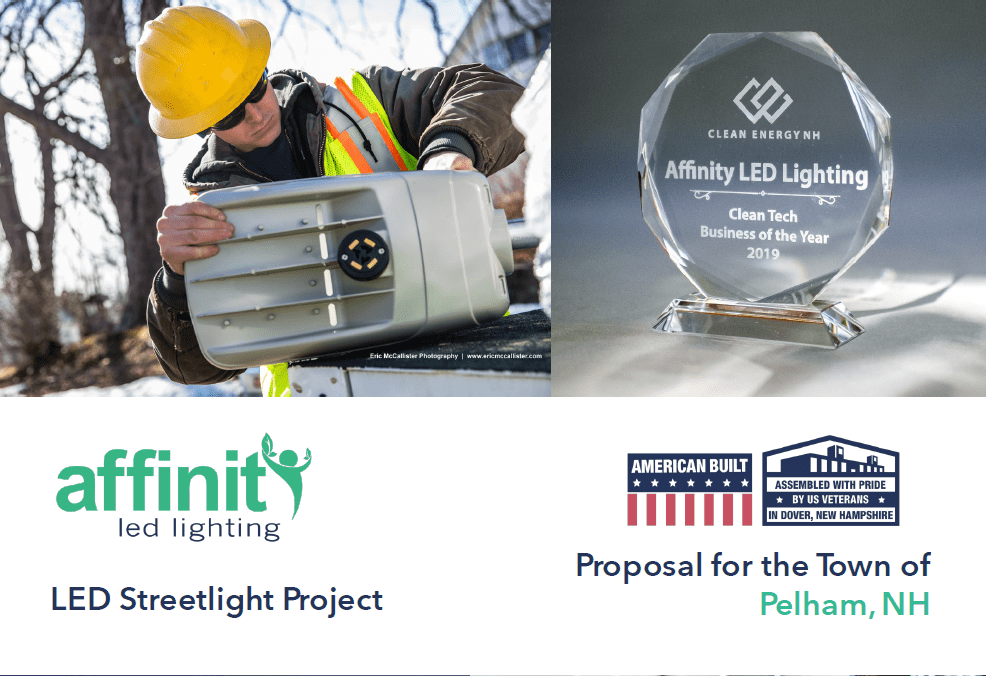
Franklin then introduced me to Affinity LED, a New Hampshire–based manufacturer and turnkey provider specializing in municipal streetlight conversions.
That introduction changed everything.
Step Three: Building the Right Team
Affinity LED brought deep regional experience, technical expertise, and—importantly—a proven track record with towns just like Pelham.
Over the next two years, the project became a collaboration among:
- The Town of Pelham
- Liberty Utilities
- Franklin Energy
- Affinity LED
Together, we worked through data reconciliation, energy modeling, fixture selection, incentives, financing structures, and long‑term maintenance considerations.
The goal wasn’t just new lights.
The goal was a smarter, more efficient, lower‑risk investment for taxpayers.
The Project at a Glance
Based on Liberty’s inventory and Affinity LED’s proposal, the project includes:
- 174 Liberty‑owned streetlights converted to LED
- American‑built LED fixtures assembled in Dover, NH by a workforce of U.S. Veterans
- “Smart‑Ready” fixtures capable of future controls and upgrades
Total Project Cost
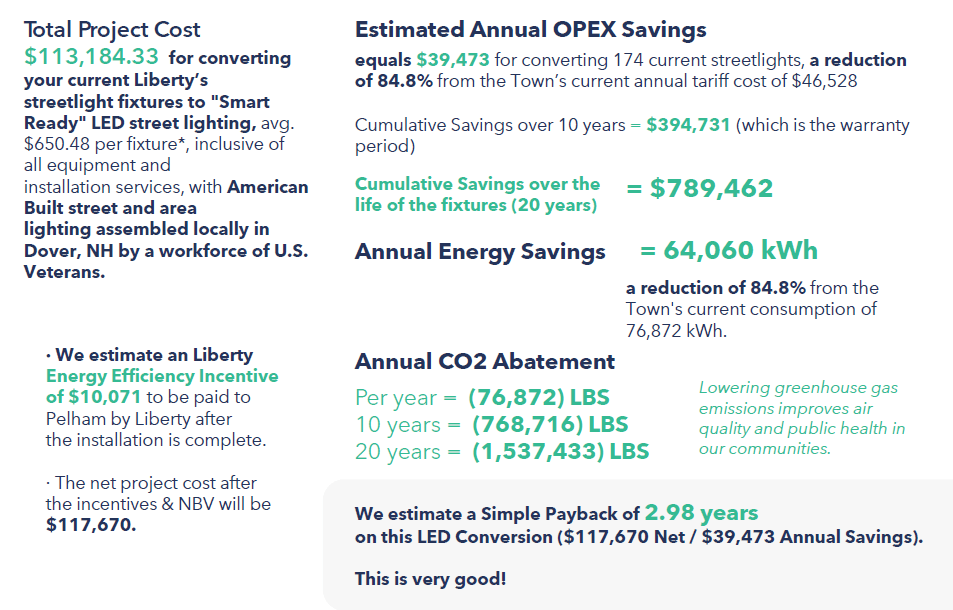
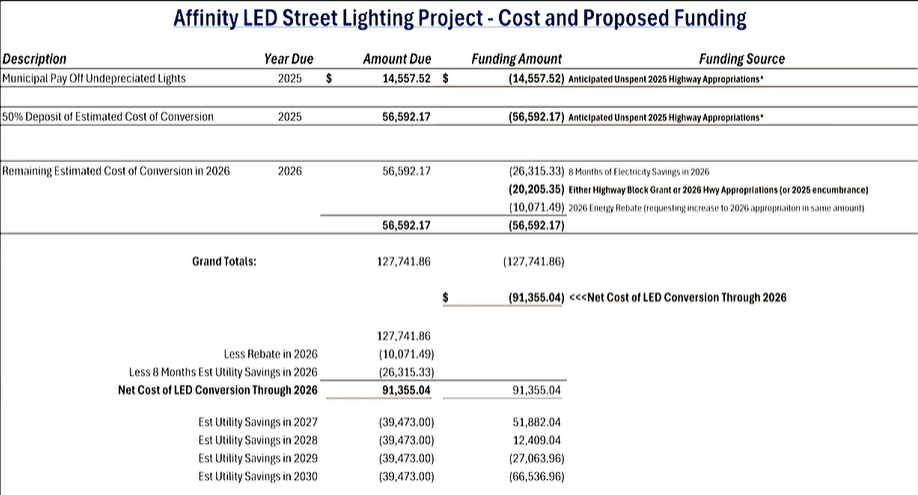
- $113,184.33 total installed cost
- Average $650.48 per fixture, including equipment and installation
Utility Incentives
- Estimated $10,071 Liberty Utilities energy‑efficiency incentive
Net Project Cost
- Approximately $117,670 after incentives and net billing value adjustments
(Final figures subject to confirmation during GIS field audit)
The Financial Impact: Savings That Matter
This is where the project becomes especially compelling.
Annual Operating Savings
- Current annual streetlight cost: $46,528
- Post‑conversion estimated cost: ~$7,055
- Annual savings: $39,473
- 84.8% reduction in annual streetlight operating costs
Payback Period
- Simple payback: 2.98 years
In other words, the project pays for itself in under three years.
Long‑Term Savings
- 10‑year savings (warranty period): $394,731
- 20‑year lifetime savings: $789,462
That’s money that can be redirected to roads, schools, public safety, or tax stabilization.
Financing Options: Paying From the Savings
Affinity LED also offers on‑bill and municipal lease financing options through partners such as Municipal Leasing Consultants.
This structure allows towns to:
- Avoid large upfront capital outlays
- Pay for the project using a portion of the monthly energy savings
- Maintain positive cash flow from day one
Simply put: the lights can help pay for themselves.
Reliability, Warranty, and Risk Reduction
Infrastructure upgrades only make sense if they reduce risk—not add to it.
This project includes:
- 10‑year equipment warranty on all LED fixtures
- 1‑year labor warranty
- Local manufacturing and support
- Simplified maintenance with standardized fixtures
Because Affinity manufactures its own fixtures, replacement parts and service are straightforward and fast—no waiting on overseas supply chains.
Environmental and Community Benefits
Beyond dollars and cents, the project delivers measurable environmental gains:
- 64,060 kWh annual energy reduction
- 76,872 lbs of CO₂ avoided per year
- Over 1.5 million lbs of CO₂ avoided over 20 years
Additional benefits include:
- Improved night visibility and public safety
- Reduced light pollution
- Better performance in fog and snow
- Lower maintenance disruptions
- Reduced solid waste through reusable installation packaging
From an Idea to the Select Board
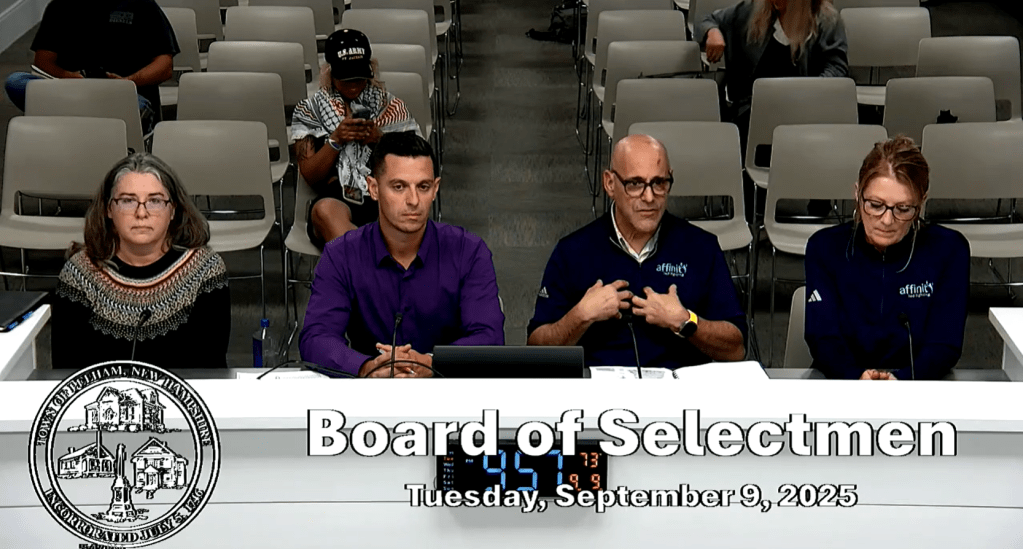
After nearly two years of coordination, analysis, and refinement, the Town, Liberty Utilities, Franklin Energy, Affinity LED, and I collectively presented the project to the Pelham Select Board.
What began as a simple question evolved into a fully developed, data‑driven proposal—one that aligns financial responsibility, environmental stewardship, and long‑term infrastructure planning.
Why This Matters
This project is proof that residents don’t need to hold office to make a meaningful impact.
By asking questions, following the data, and working collaboratively, it’s possible to uncover hidden inefficiencies and turn them into real opportunities for savings and improvement.
Pelham’s LED streetlight project isn’t just about brighter roads.
It’s about smarter governance, better data, and investing in solutions that serve the community today—and for decades to come.
 Quality Compliance & Certification Services